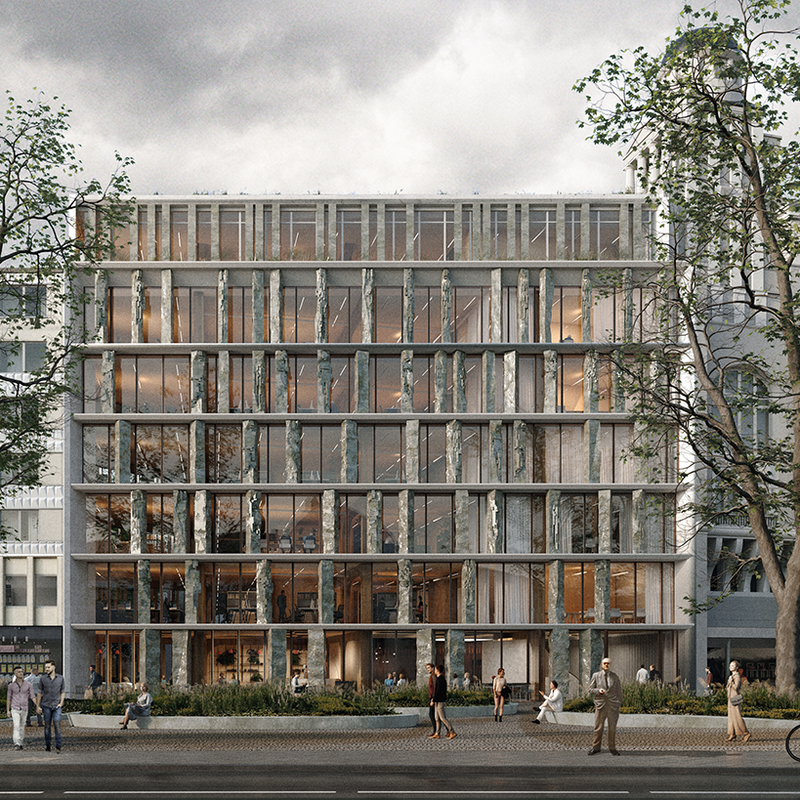
Goetheplatz has been one of Frankfurt’s most important public spaces for five centuries. Once a field outside the medieval city walls, the Rossmarkt area remained unfortified until the 17th century and functioned variously as a horse market, a site for tournaments, and a place of public executions. 

Following an invited international design competition with six architectural practices, ACME has emerged with the winning scheme for Goetheplatz 1.


Project details +

Project details

LOCATION: Frankfurt, Germany

DATE: 2023-Ongoing

CLIENT: Raiffeisen Immobilien Kapitalanlage GmbH 

STATUS: Concept Design

SIZE: 9,200 sqm GIA 

Credits +

Credits

ACME: Amanda Callaghan, Natalie Dubrovska, Igor Gola, Li Zhi Loh, Friedrich Ludewig, Heidrun Schuhmann, Keigo Yoshida


Goetheplatz has been one of Frankfurt’s most important public spaces for 500 years. Any traces of its history are barely legible on site; most of them have disappeared due to wartime destruction, reconstruction and remodelling, leaving behind a public space whose façades contribute little to its character. The new construction of Goetheplatz 1 provides an opportunity to strengthen the character and identity of Goetheplatz.

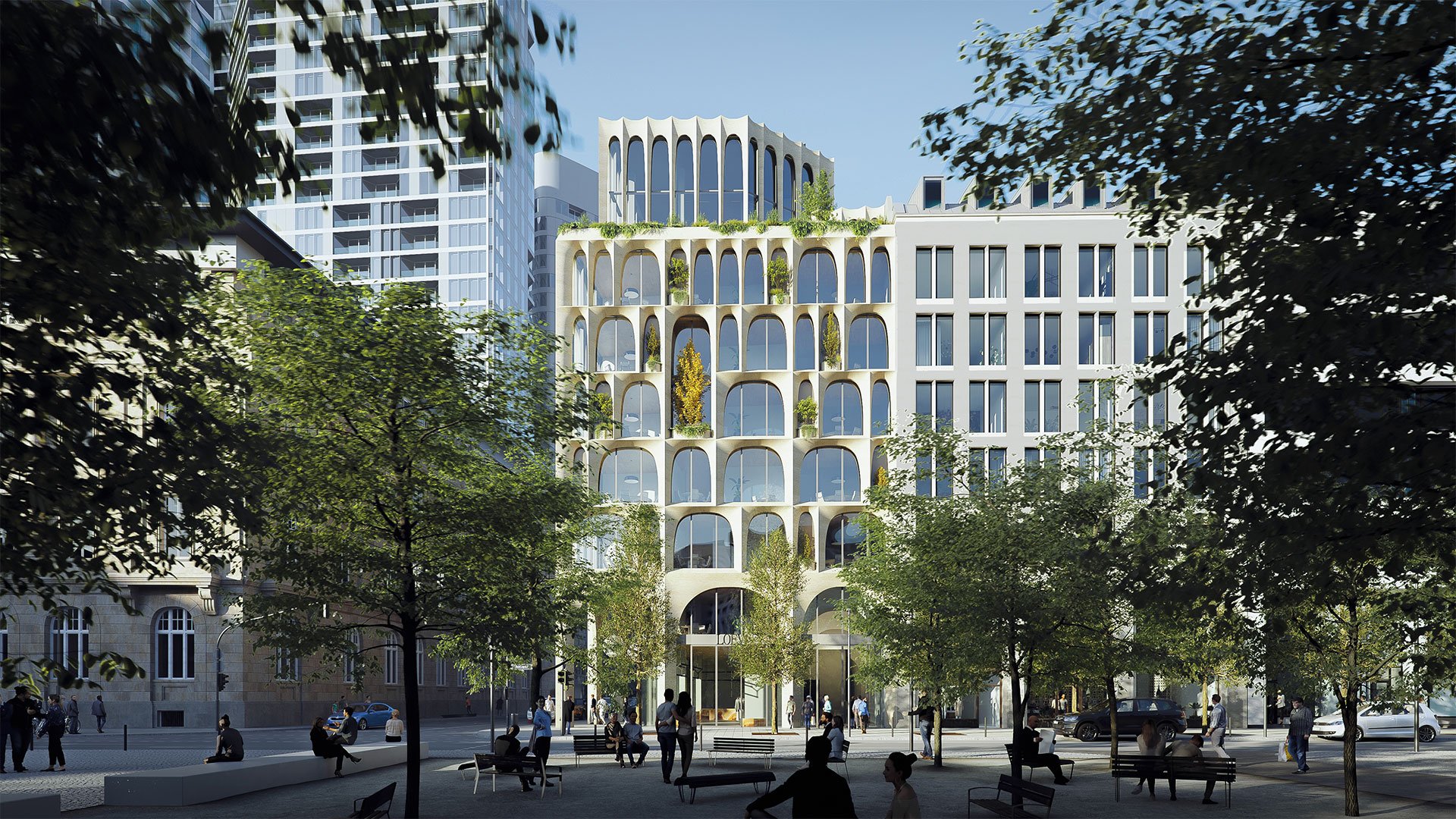
ACME is delighted to have convinced the competition jury with our entry. Our design celebrates Goetheplatz and will create a new sculptural civic building with a load-bearing vaulted stone façade in the heart of Frankfurt.
Sustainability is at the centre of the client’s and future tenants’ requirements and ACME will achieve this by reusing materials and building in timber and stone, with the aim of developing a building with the lowest carbon footprint in Frankfurt.”

Friedrich Ludewig, Founding Director - ACME

Goetheplatz 1 is envisioned as a contemporary landmark that both strengthens the historic character of one of Frankfurt’s oldest squares and sets a benchmark for sustainable, circular, and resource-efficient construction in the 21st century.

Generous planting integrated within one third of the arches brings greenery to the façade, creating small habitats that foster local biodiversity. Inside, exposed timber soffits celebrate the building’s materiality, while heating and cooling are delivered through ceiling-mounted radiant clay panels.

Frankfurt
Leistadt Quarry
Neckar Valley Quarry


Avoiding the use of stone as a thin cladding material, the design revives a traditional Frankfurt vernacular by employing solid stone and timber as primary structural materials. The sandstone, sourced and mined locally from the Leistadt quarry and the Neckar Valley quarry, anchors the building materially and culturally within its regional context


Articles

Related Projects